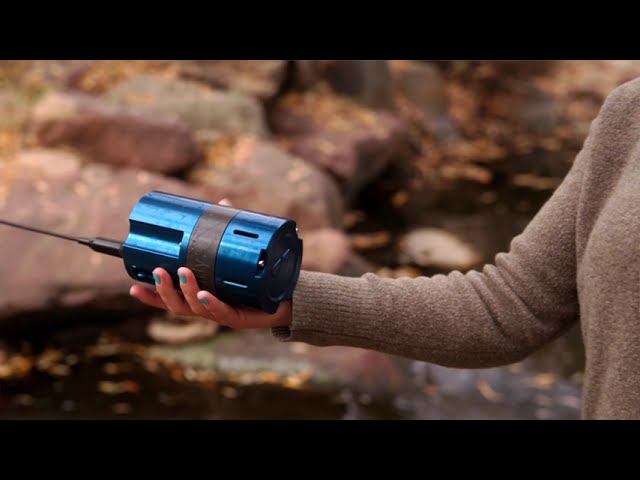
Meet the Lume

Continuous microbial water quality monitoring

The Lume is the world’s first fully integrated ultratrace microbial quantification fluorimeter. It measures tryptophan-like fluorescence in place and reports E. coli risk estimates over cellular or satellite networks.

Drinking water Recreational water Food safety Wired · WiFi · Cellular · Satellite
Performance

Proven performance for microbial risk assessment

Field and laboratory evaluations demonstrate that Lume provides reliable quantitative and categorical estimates of microbial contamination across environmentally relevant concentration ranges. Model-estimated E. coli concentrations closely align with laboratory reference methods over approximately three orders of magnitude.

82%
Continuous estimates within the laboratory reference method’s confidence intervals, 0–1,000 CFU/100 mL
>94%
Categorical accuracy with site-specific calibration
7%
Mean absolute percentage error (log-transformed)
1 yr
Battery life on hourly sampling
EPA alternative indicatorMeets the EPA’s alternative indicator requirements for swimming-water safety, validated against Colilert and membrane filtration methods.
AccuracyCan exceed 90% accuracy at both drinking water and recreational thresholds.
Gold Standard validatedThe only sensor validated under Gold Standard’s digital monitoring program to replace laboratory and field-kit E. coli testing in carbon-financed water projects.
Virridy Lume sensor deployed in an irrigation ditch
The Virridy Lume: a sensitive, continuous, in-situ, remotely reporting tryptophan-like fluorescence sensor for semi-quantification of fecal contamination as E. coli.
Overview

Continuous water quality monitoring

Public health and pollution-response decisions depend on timely, spatially resolved information. Traditional culture-based sampling typically delivers results 24–48 hours after collection and is often too sparse to capture short-lived or localized contamination events. As a result, many contamination pulses remain undetected.

The Lume’s primary configuration measures tryptophan-like fluorescence (TLF) to estimate microbial contamination risk in near real time. The same platform also supports chlorophyll-a (Cl-A) for algae monitoring and fluorescent dissolved organic matter (FDOM) for tracking dissolved organics and nutrient loading. Each sensor operates autonomously and transmits data via cellular or satellite networks to a secure cloud platform.

One platform, three measurement modes — thousands of in-situ estimates for the cost of a single grab sample.

Applications

Drinking water, recreational water, and irrigation water

Drinking water

Protecting the water people drink, from source to tap

Culture-based testing reports results a day or two after the sample is taken, and is far too sparse to catch a short-lived intrusion before it reaches consumers. Lume runs continuously on wells, intakes, and chlorinated distribution systems, screening source water and confirming that treatment and disinfection are holding between lab tests.

Performance is proven at the low end: Lume classified at the ≥10 CFU/100 mL drinking-water threshold with 85% balanced accuracy against 216 paired Compartment Bag Test observations in Rwanda and Kenya.

Where Lume works
Community wells & piped systemsSource protectionFiltration & disinfection verificationReservoir & intake monitoringDistribution-system screening
See the drinking-water validation
A field technician holds Lume sensor housings at a livestock water point in northern Kenya as camels drink from the trough
Recreational water

Same-day answers for beaches, rivers, and lakes

Beach testing typically reports E. coli 18–24 hours after the sample, after swimmers have already been in the water. Lume measures contamination risk continuously, supporting same-day advisories and public-facing dashboards that keep communities informed, while arrays localize sources across a reach.

On the Seine in Paris, three Lume sensors classified the recreational threshold with 94% balanced accuracy on held-out data. Lume is deployed today with cities, utilities, and watershed groups.

Where Lume works
Beaches & swim areasRivers, parks & marinasSame-day swim advisoriesPublic dashboards & alertsSource tracking across reaches
A Virridy Lume sensor on the bank of the Colorado River in the Grand Canyon
Irrigation water & food safety

Monitoring the water that grows our food

Contaminated produce keeps making people sick, and the industry cannot tell whether its interventions work. Lume monitors the two points where water touches the crop, pre-harvest irrigation sources and post-harvest process water, giving growers, processors, and the brands behind them an auditable, continuous record instead of a handful of grab samples.

Because Lume performs at drinking-water concentrations, chlorinated process water is well within range: the intake can be measured before and after dosing, not just at the source.

Where Lume works
Pre-harvest irrigation source waterPost-harvest process & wash waterReading across disinfectionProduce food-safety verificationSupplier-water assurance for brands
Produce Water Sentinel
Lume water-quality sensors in yellow, green and blue, shown with Virridy shipping boxes ready for deployment
Where the Lume installs

Real-world applications

Lume is deployed across a range of monitoring contexts, including drinking water source protection, recreational water management, agricultural irrigation and produce food safety, and wastewater discharge monitoring.

Illustrated watershed from mountains to sea marking the places the Lume is installed: reservoir and source-water intake, treatment and distribution systems, community wells, rivers and recreation, irrigation source and farm return flows, urban stormwater and CSO outfalls, wastewater and receiving waters, and beaches and coast.
Outcomes

What Lume enables

Continuous microbial data allow organizations to move from reactive to proactive water quality management. By capturing rapid changes that occur between laboratory samples, Lume supports earlier detection of contamination events and more confident decision-making.

  • Detect contamination as it occurs
  • Support same-day recreational water advisories
  • Screen irrigation and food-processing water for fecal contamination
  • Continuously screen source and receiving waters between lab analyses
  • Prioritize confirmatory sampling
  • Improve situational awareness during storms and infrastructure failures
  • Reduce uncertainty between sampling campaigns
Arrays

Sensors over samples

An array provides the temporal and spatial coverage that single grab samples cannot. By measuring every few minutes, arrays capture short-duration events that a weekly schedule typically misses. Placing sensors to bracket reaches, confluences, and outfalls adds spatial resolution.

  • Bracket reaches, confluences, and outfalls
  • Localize hotspots and rank likely sources
  • Higher decision accuracy for advisories and source ID
  • Reduce routine logistics and lab spend
  • Rapid outcome verification of BMPs and repairs
  • Monitor chlorinated piped water and distributed systems
Platform

Three measurement modes, one platform

Interchangeable optical configurations address different water quality challenges, all sharing the same hardware, connectivity, and cloud analytics.

Ex 280 nm / Em 350 nm

Lume TLF — Microbial contamination

Measures tryptophan-like fluorescence as a real-time proxy for fecal contamination and E. coli. The primary Lume configuration, validated across drinking water, natural waters, and wastewater applications worldwide.

Drinking water · Recreational water · Irrigation & food safety · Source tracking
Ex 470 nm / Em 680 nm

Lume Cl-A — Algae

Measures chlorophyll-a fluorescence for continuous monitoring of algal biomass and bloom detection. Enables early warning of harmful algal blooms (HABs) in reservoirs, lakes, and intake waters.

Reservoirs · Lakes · Intakes · HAB early warning
Ex 365 nm / Em 480 nm

Lume FDOM — Dissolved organics & nutrients

Measures fluorescent dissolved organic matter as an indicator of dissolved organic carbon, humic substances, and nutrient loading. Supports watershed characterization and treatment process monitoring.

Nutrient loading · DOC tracking · Treatment optimization

Lume design

The Lume is a fully integrated, internet-connected (cellular and satellite) sensor solution. The sensor head can be configured for TLF (microbial contamination), Cl-A (algae), or FDOM (dissolved organics), alongside integrated turbidity and temperature measurements. Sampling can be remotely programmed for between 30 seconds and 24 hours, and reporting between 5 minutes and several days. With 24-hour reporting, the battery will last up to a year on a single charge. The sensor head can be cleaned with a hand-twist removal of the cover. The battery can be charged with solar or wall power. The antenna can be internal to the Lume, an external whip, or on a wire.

Lume V1.2 exploded view showing optical bay electronics, optical assembly, and full sensor assembly

Hardware and analytics

Sensor capabilities

  • TLF mode: E. coli and microbial contamination (280/350 nm)
  • Cl-A mode: algal biomass and bloom detection (470/680 nm)
  • FDOM mode: dissolved organics and nutrient loading (365/480 nm)
  • Turbidity sensor for NTU quantification
  • Temperature sensor for data and correction
  • GPS coordinates
  • No regular calibration or cleaning required
  • Lower retail cost than competitors

Operations

  • Sampling: 30 sec to 24 hours (remote config)
  • Reporting: 5 min to several days
  • Battery: up to 1 year (hourly sampling, 24h reporting)
  • Power: solar or wall charging
  • Cellular & satellite connectivity
  • Single integrated unit, no external power or telemetry
  • Machine learning microbial quantification
  • Protected online dashboard and API

Implementation design

  • Array design: joint siting plan to bracket sources
  • Deployment: mount, power, connect. Data in minutes
  • Operations: alerts for exceedances and events
  • Periodic siting optimization as patterns emerge
  • Verification via continuous data streams

Data governance & integration

  • Role-based dashboard access
  • Export to existing platforms via API
  • Audit trail: device health, uptime, data quality
  • Documentation: SOPs, siting rationales, QA/QC
Research

Built on science. Ready for scale.

Lume builds on peer-reviewed research and multi-site field validation to address the limitations of traditional microbial monitoring approaches. By combining optical sensing with adaptive data modeling, Lume maintains performance under changing environmental conditions where static thresholds and infrequent sampling fall short.

Every Lume deployment generates a continuous, high-resolution record of microbial risk, enabling utilities, regulators, and watershed managers to identify contamination sources, verify the effectiveness of interventions, and build defensible compliance records without the cost and delay of repeated laboratory analysis.

Start an array
$200/ month per site
10+ unit standard deployment · 12-month minimum
  • Device lease included
  • Cellular/satellite connectivity
  • Secure cloud hosting & data dashboard
  • API access
  • Fleet health monitoring
  • Remote updates
  • Onboarding & siting support
Talk to Alex Johnson
Chief Strategy Officer · alex.johnson@virridy.com
Partners

Our partners

Working with leading organizations to advance continuous water quality monitoring worldwide.

USAID
U.S. National
Science Foundation
NASA
Gates Foundation
Moore Foundation
Walton Family Foundation
Mortenson Construction
U.S. Air Force
blues
City of Boulder
City of Denver
Millennium Water Alliance
The Freshwater Trust
City of Paris
British Geological Survey
Denver Water
NSF ASCEND Engine
Current Water Innovation
CHARLES RIVER
WATERSHED
ASSOCIATION
Gold Standard
Get in touch

Get in touch

Lume sales & deployments

Alex Johnson, Chief Strategy Officer

alex.johnson@virridy.com

+1-503-504-9668

General inquiries

info@virridy.com

Send a message